The $600M Warehouse Fire and the Insider Threat Gap
An employee torched a $600M Kimberly-Clark warehouse last week. The insider threat gap in distribution centers is wider than most operations teams realize.
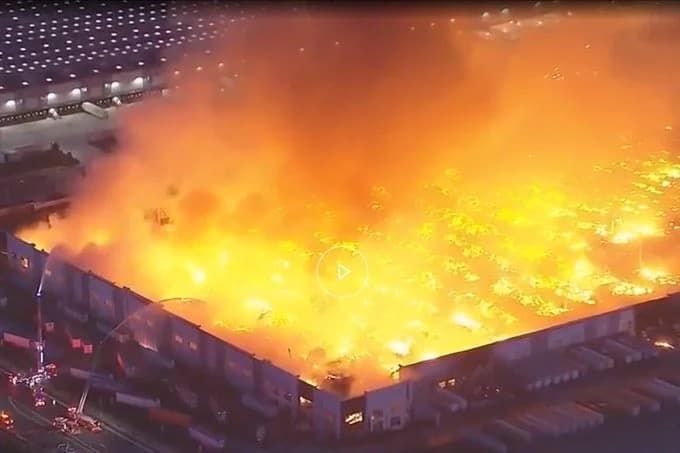
One Employee, Six Alarms, $600M Gone
On April 7, 2026, a six-alarm fire destroyed a 1.2 million square foot Kimberly-Clark distribution center in Ontario, California. Property damage came in around $600 million (Insurance Journal). The roof collapsed. Every product inside burned.
The arsonist was not an outsider. Police arrested Chamel Abdulkarim, a 29-year-old employee of a third-party distributor working at the site. Video reportedly shows him lighting packages of toilet paper inside the warehouse (CBS Los Angeles). His stated motive, per court records: pay grievances.
Bloomberg Intelligence estimates the loss could disrupt 3% of Kimberly-Clark's West Coast sales and hit consumer markets across California, Arizona, and Nevada (Bloomberg).
Why This Is Not Just a Fire Story
Distribution centers sit at the intersection of several converging risks. They are fast-paced, labor-intensive, and increasingly dependent on contract and third-party staff. ASIS International put it directly: these same characteristics make distribution centers one of the most vulnerable points in the supply chain, with exposure to cargo theft, insider collusion, documentation fraud, and physical sabotage (ASIS Security Management).
Flashpoint's 2026 threat outlook found that geopolitical tensions and labor friction are the key drivers of insider incidents this year. Recruiting an insider is often cheaper than breaching a hardened perimeter (Flashpoint). That applies to cyber attacks. It also applies to physical ones.
The Gap Most Operations Teams Miss
- Third-party staff are often outside the HR loop. Contract workers, temp agencies, and logistics subcontractors can access the full warehouse floor without appearing on the direct payroll. Standard insider threat programs may not see them.
- Physical and personnel security live in separate silos. EHS owns fire safety. Facilities owns access control. HR owns labor relations. The pattern that predicts an arson, such as a wage dispute paired with an angry social media post, often falls between all three.
- External risk signals rarely cross the threshold into ops. Regional wage actions, local crime spikes, and labor unrest at neighboring facilities are treated as news, not as precursors. They should be treated as precursors.
What Teams Should Do This Week
Map your third-party footprint. For every distribution center, list the agencies and subcontractors with physical access. Confirm that each has a documented screening process and a clear chain of escalation for grievance or misconduct reports.
Tie personnel signals to facility risk. If a site has active labor disputes, wage complaints, or recent terminations in the contract labor pool, treat that site as higher risk. Add extra supervision, camera review, and fire-watch rounds during shift changes.
Bridge physical and geopolitical risk monitoring. External conditions, such as a local strike wave, a nearby protest, or a regional economic shock, change the probability of a single-site incident. Orion monitors physical and geopolitical risk across 190 countries and can flag conditions around a facility before they become an event, complementing internal HR and security workflows.
Rehearse the insider scenario. Most tabletop exercises focus on natural disasters or external attacks. Run one on a disgruntled-insider arson at a key node. Identify who notices first, who calls whom, and how quickly product flow reroutes.
Wrapping Up
One motivated insider can erase a billion dollars of value in a morning. The signal was there. The question for every operations leader is whether your team would have seen it. Request a demo to see how Orion watches the conditions that drive these events.
See how Orion monitors these risks in real time
Get adaptive risk alerts across 190 countries, updated continuously from 100,000+ data sources.
Request a Demo →Related
CISA to Infrastructure: Plan for Going Offline
CISA's CI Fortify initiative tells critical infrastructure operators to prepare for weeks of isolated operations during cyber conflict. Here's what it means.
ArticleHurricane Season 2026: Prepare Operations Before June 1
The 2026 hurricane season starts June 1 with 11-16 storms forecast. Below-average counts don't mean low risk. Here's how operations teams should prepare now.